03 - Generate Synthetic Dataset
This section generates synthetic credit card transaction data for fraud detection. We create our own data rather than using public datasets to avoid licensing issues and ensure realistic fraud patterns. The synthetic data mimics real-world characteristics: fraudsters make larger transactions, operate at unusual hours, and show rapid transaction bursts.
ML and CCFD Workflow
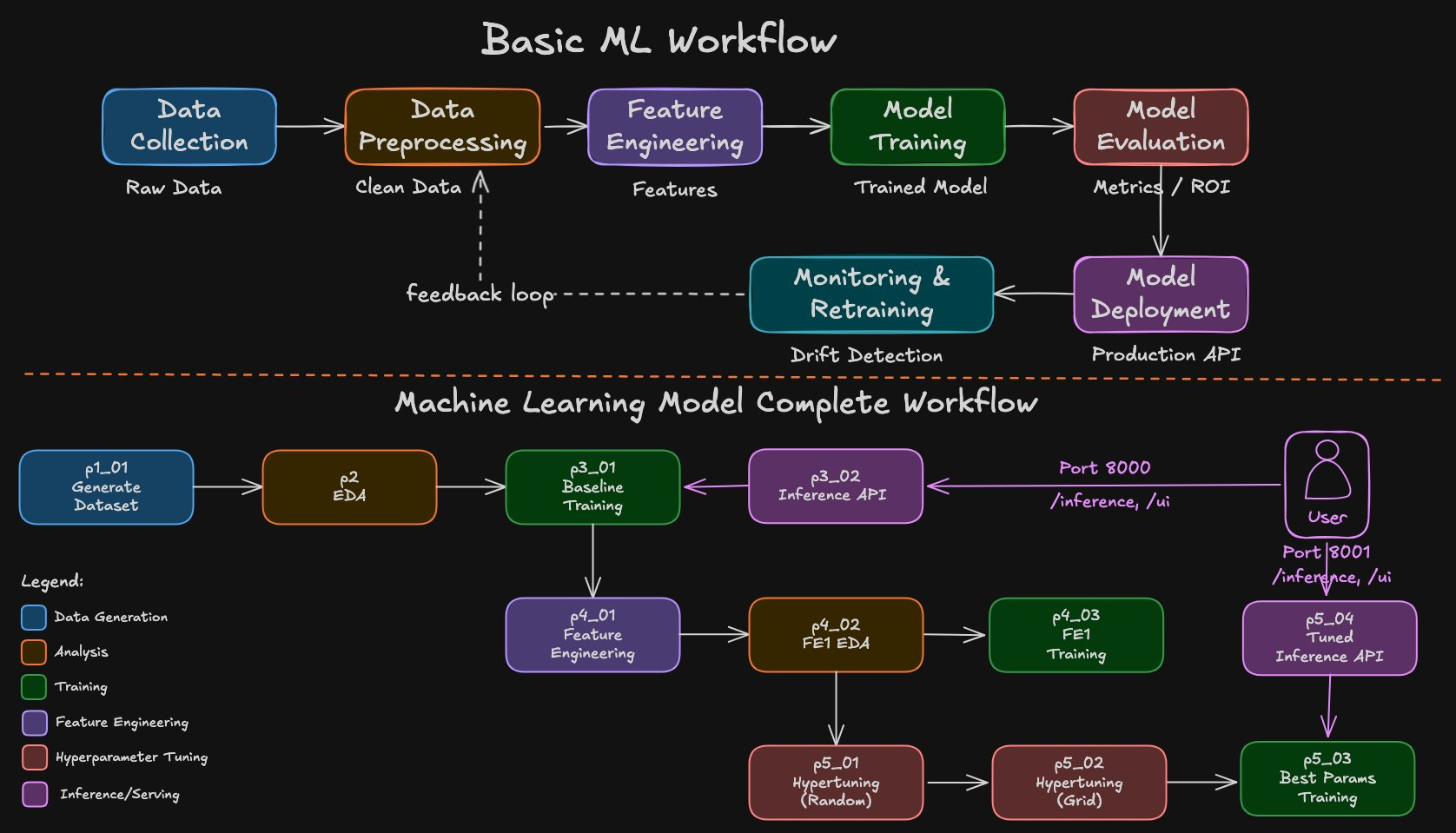
Architecture
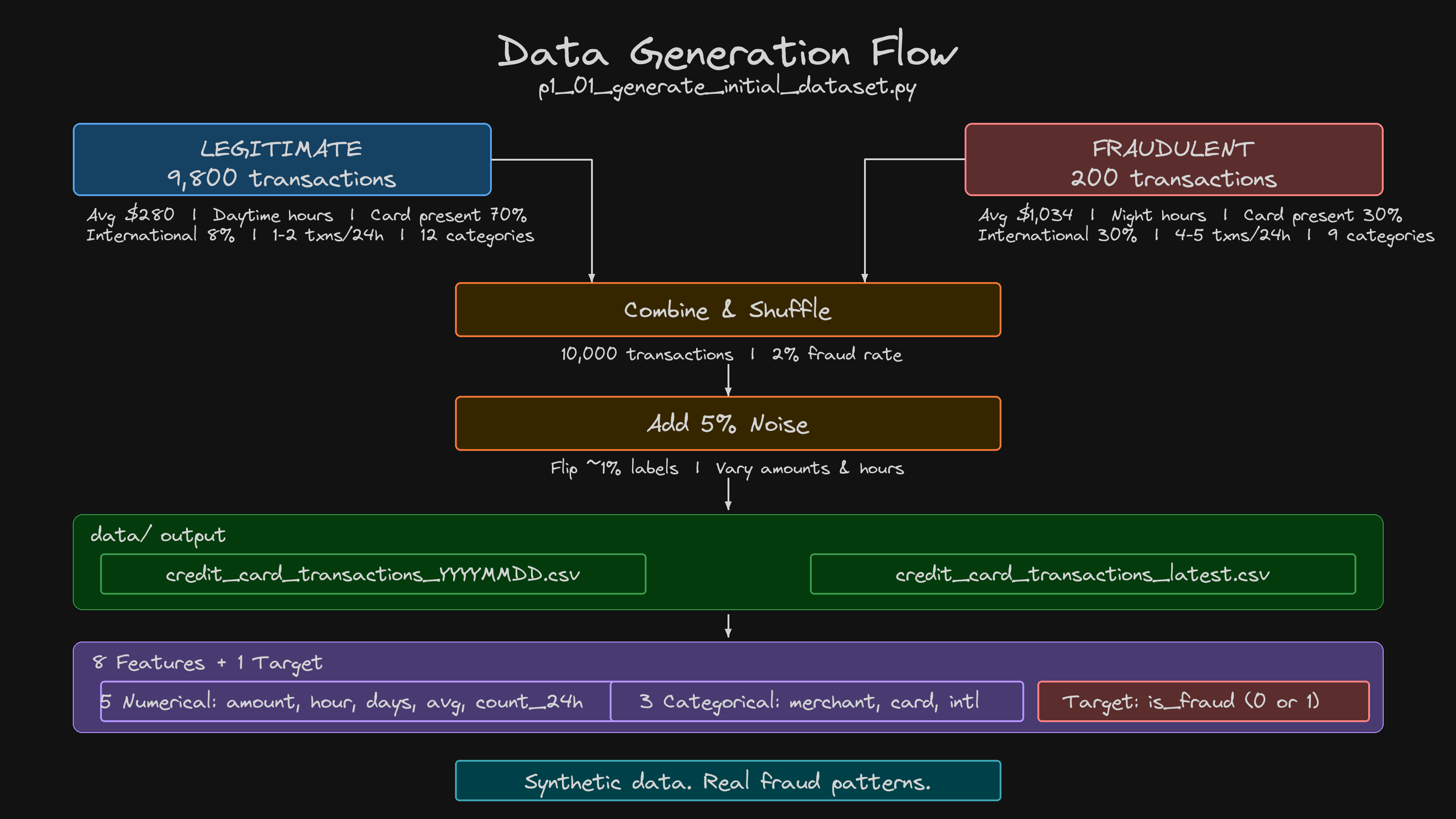
Table of Contents
| Step | Topic |
|---|---|
| Step-01 | Review the Generator Script |
| Step-02 | Run Data Generation |
| Step-03 | Verify the Dataset |
Pre-requisite: Python Environment Setup
# Create conda environment
conda create -n mlops-env1 python=3.14 -c conda-forge -y

# Activate environment
conda activate mlops-env1

# Install dependencies (locked versions)
cd ccfd-project
pip install -r requirements.txt
Note: All sections in this course use the same
mlops-env1environment. You only need to create it once. After that, just activate it withconda activate mlops-env1before running any scripts.
Step-01: Review the Generator Script
The generator script lives in the ccfd-project/ folder:
| File | Description |
|---|---|
ccfd-project/p1_01_generate_initial_dataset.py | Generate 10,000 transactions (initial dataset) |
Project Structure
03_Generate_Dataset/
├── README.md                          # This file
└── ccfd-project/
    ├── p1_01_generate_initial_dataset.py   # Generator script
    └── requirements.txt                    # Python dependencies
How the Generator Works
The script creates two types of transactions: - Legitimate (9,800): Normal spending patterns, daytime hours, moderate amounts, card present - Fraudulent (200): Suspicious patterns, higher amounts, night hours, rapid bursts, card not present - 5% noise added for realism (amount variance, hour jitter, 1% label flips)
Step-02: Run Data Generation
Alternative: If you're using the shared folder, run all commands from
ccfd-project-main/instead. See Shared Project Folder in the root README.
Expected Output:
======================================================================
CREDIT CARD FRAUD DETECTION - DATASET GENERATION
======================================================================

Generating transactions...
   Legitimate: 9,800 transactions
   Fraudulent: 200 transactions
   Applied 5% noise for realism

======================================================================
DATASET SUMMARY
======================================================================
   Total Transactions: 10,000
   Fraud Rate:         2.98%

   Legitimate: avg $280.68 | range $5.00 - $3259.33
   Fraudulent: avg $1034.33 | range $5.71 - $3243.64

======================================================================
FILES SAVED
======================================================================
   Timestamped: data/credit_card_transactions_YYYYMMDD_HHMMSS.csv
   Latest:      data/credit_card_transactions_latest.csv

======================================================================
DATASET GENERATION COMPLETE
======================================================================
Files Created:
| File | Description |
|---|---|
data/credit_card_transactions_latest.csv | Main dataset (always use this) |
data/credit_card_transactions_YYYYMMDD_HHMMSS.csv | Timestamped backup |
Step-03: Verify the Dataset
Check File Exists and Row Count
Expected:
Preview the Data
Expected:
transaction_amount,transaction_hour,days_since_last_txn,avg_transaction_amount,merchant_category,card_present,international,transaction_count_24h,is_fraud
Dataset Characteristics
Features Generated
| Feature | Type | Description |
|---|---|---|
transaction_amount | Float | Dollar amount ($5 - $5000) |
transaction_hour | Int | Hour of day (0-23) |
days_since_last_txn | Int | Days since last transaction |
avg_transaction_amount | Float | Customer's historical average |
merchant_category | String | Type of merchant |
card_present | String | yes/no, physical card used |
international | String | yes/no, cross-border transaction |
transaction_count_24h | Int | Transactions in last 24 hours |
is_fraud | Int | Target: 0=legitimate, 1=fraud |
Fraud Patterns Built Into Data
| Pattern | Legitimate | Fraudulent |
|---|---|---|
| Average Amount | ~$280 | ~$1,034 |
| Transaction Hour | Daytime (9-18) | More uniform, slight night bias |
| 24h Transaction Count | 1-2 | 4-5 (rapid bursts) |
| Card Present | 70% yes | 30% yes |
| International | 8% yes | 30% yes |
These patterns allow the ML model to learn real fraud indicators.
Next Steps
| Next | Topic | What You'll Do |
|---|---|---|
| 04_Model_Training_and_Inference | Train & Serve | Train a baseline model and serve predictions via API |
Prefer to learn by watching?
The video course builds this whole project with you on screen, step by step.
02 - Setup Python Environment Next: 04 - Model Training and Inference