01 - Introduction
Before we write any code, this section shows three things: what you will build, the problem we solve and how we measure it in dollars, and the machine learning workflow the whole project follows.
Table of Contents
| Step | Topic |
|---|---|
| Step-01 | Welcome: What You Will Build |
| Step-02 | Before You Start |
| Step-03 | The Fraud Problem, in Dollars |
| Step-04 | The ML Workflow and How Our Project Follows It |
Step-01: Welcome: What You Will Build
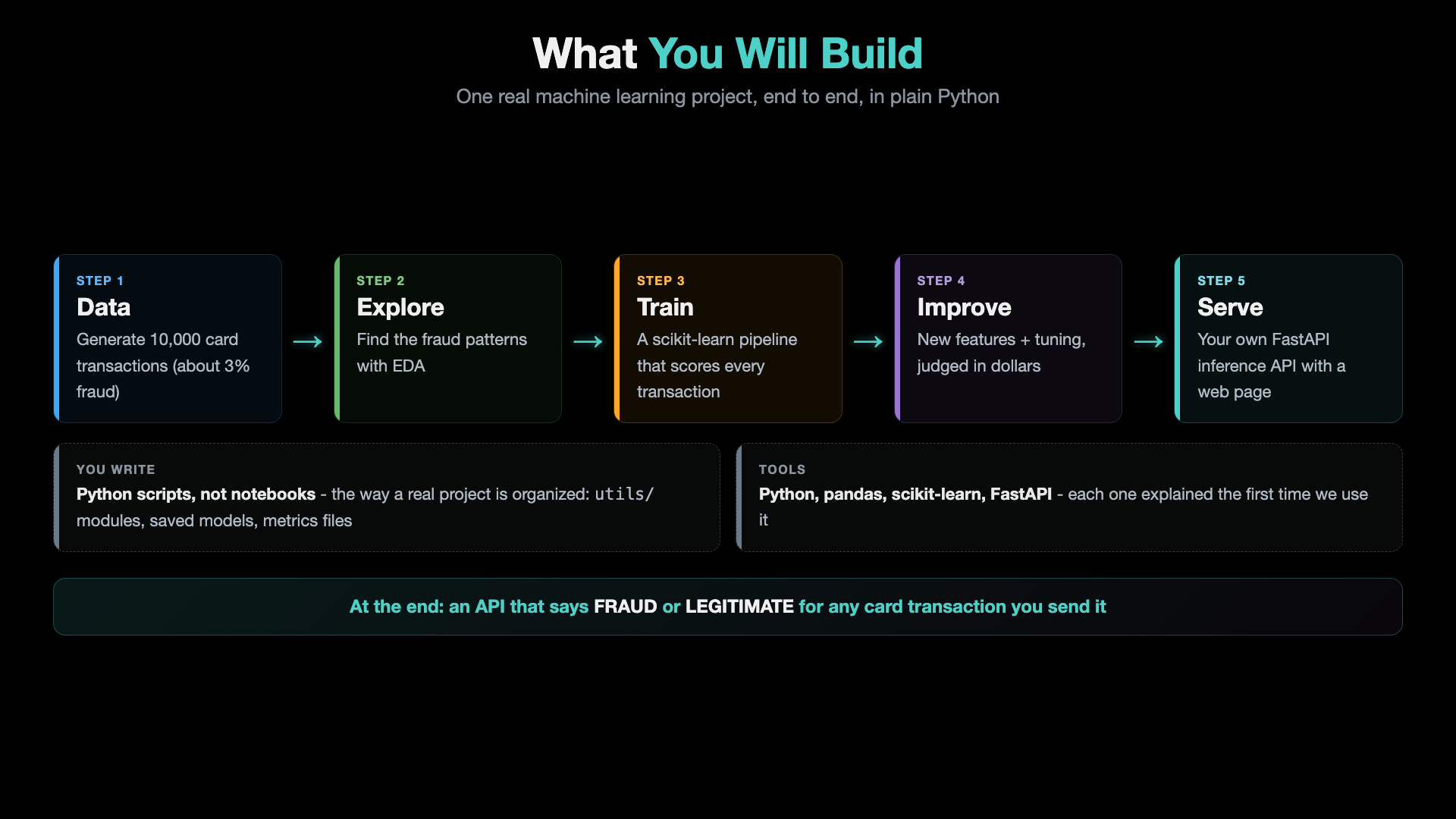
You build one complete machine learning project in Python: a credit card fraud detector, from raw data to your own prediction API. It is plain Python scripts, not notebooks, organized the way real projects are.
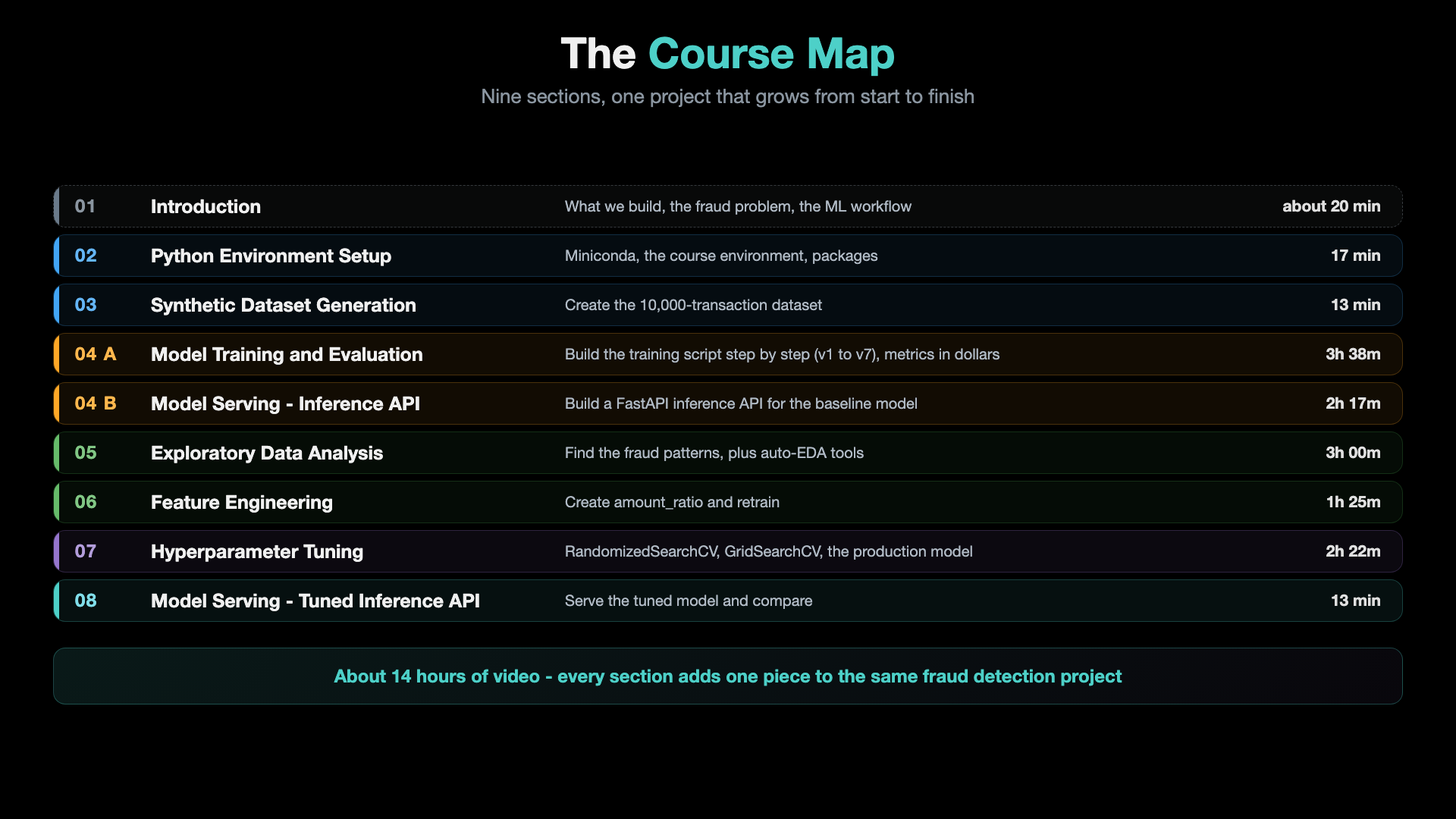
The course has nine sections, and every section adds one piece to the same project:
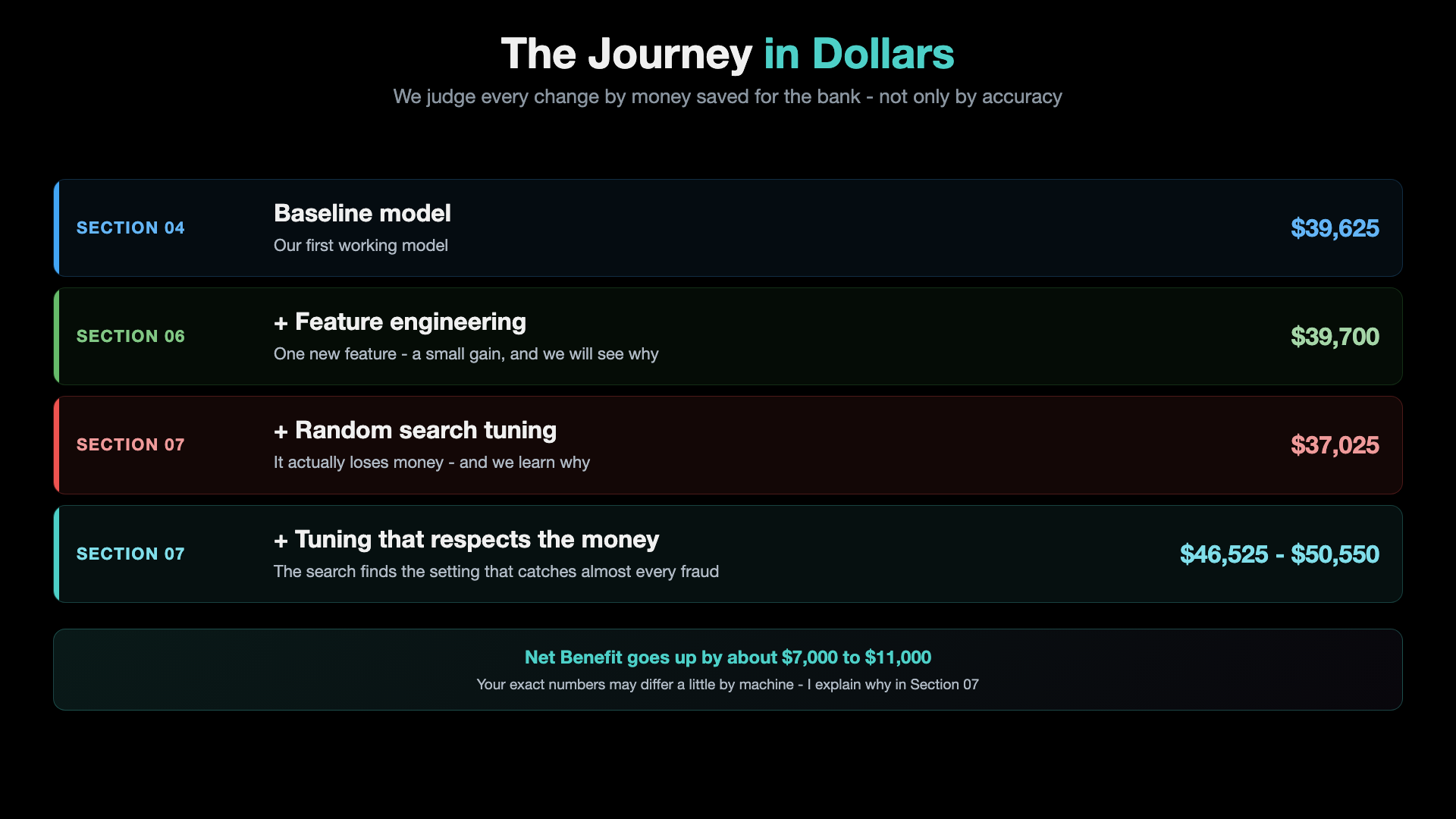
We judge every change by the money it saves the bank:
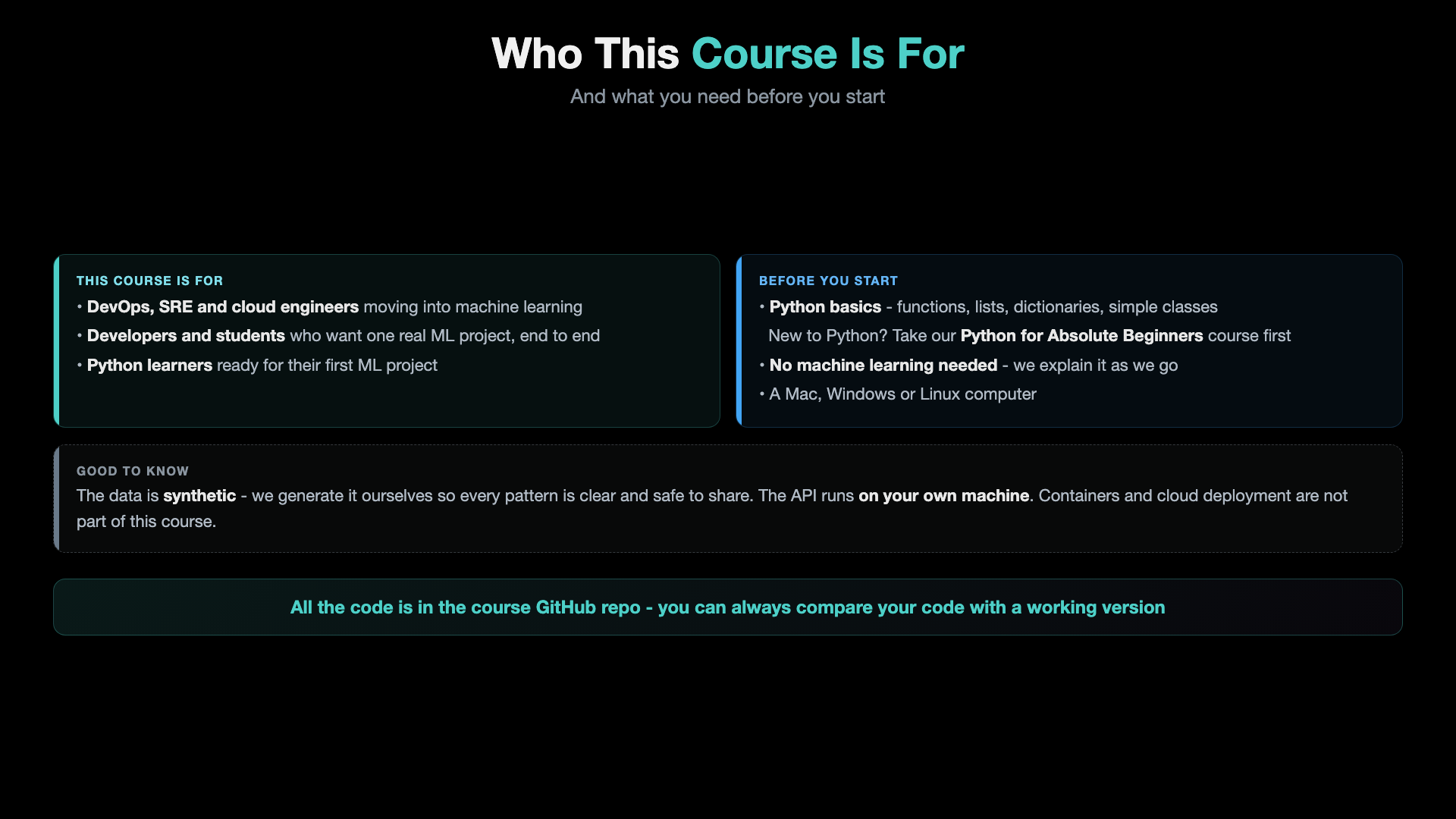
Who this course is for, and what you need before you start:
Step-02: Before You Start
- Python basics: functions, lists, dictionaries and simple classes. New to Python? Take our Python for Absolute Beginners course first.
- Your numbers may differ. Most of this course was recorded on an Intel Mac, and the final runs (the numbers you see in the slides and READMEs) were done on an Apple Silicon Mac. So you will see differences between the videos and the written numbers, for example $46,525 on camera vs $50,550 in Section 07, and the winning
class_weightcan come out as 1:100 or 1:200. Your own results depend on your processor, its math library, and small numerical differences in a search that does not always fully converge. The improvement story stays the same. Section 07 explains why this happens. - About MLflow, KServe and "advanced sections": when a lecture mentions MLflow, KServe, DVC, Docker, Kubernetes or "advanced sections", it refers to our MLOps courses. This course covers the machine learning side end to end.
- If
pipis missing in a new conda environment, runconda install pipinside it (Section 02).
Step-03: The Fraud Problem, in Dollars
Our data has 10,000 card transactions, and only 298 of them are fraud, about 3%. That makes accuracy a trap: a "model" that says legitimate to every transaction is 97% accurate and catches zero fraud.
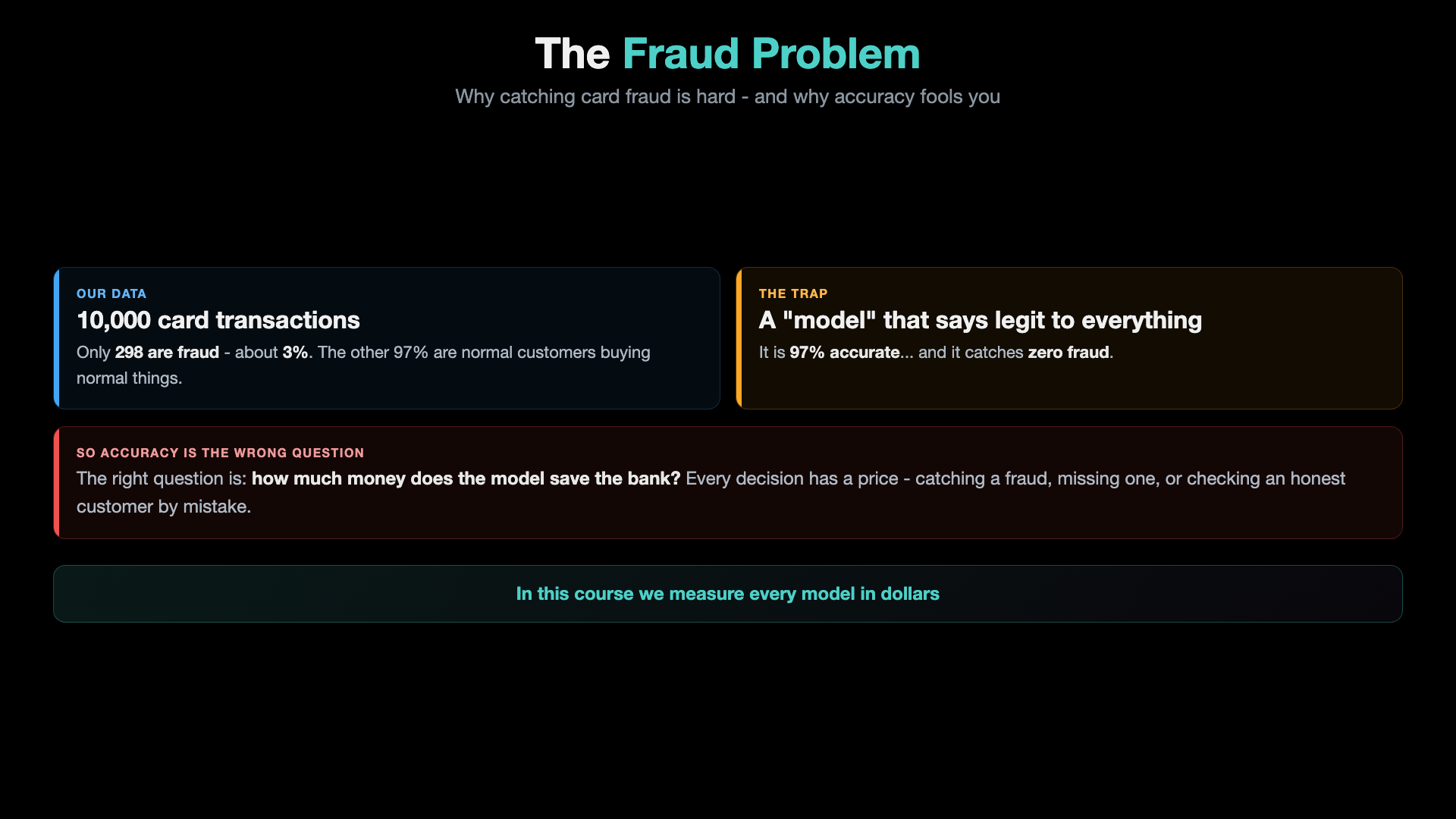
So we ask a better question: how much money does the model save the bank? Every decision has a price:
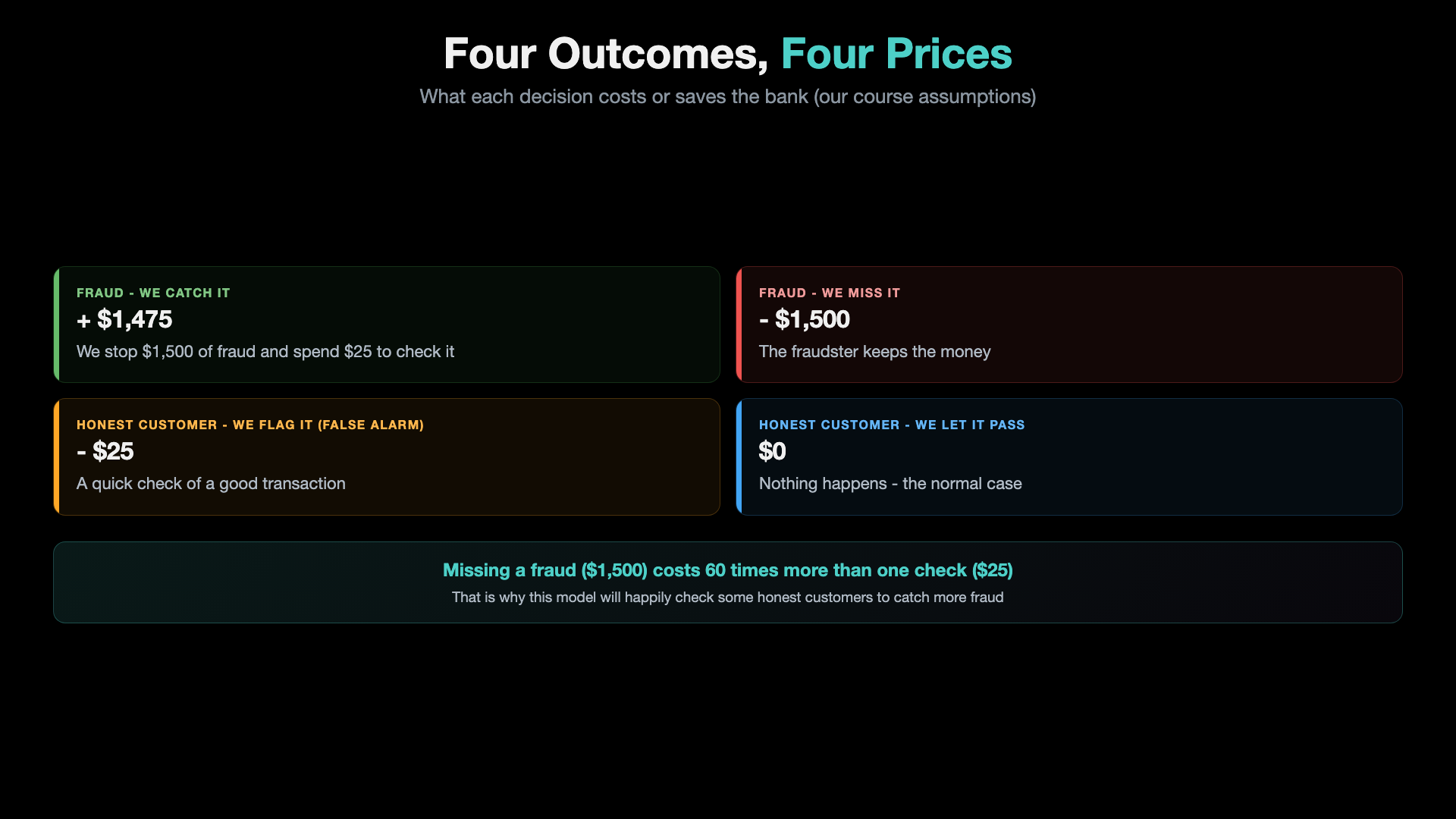
| Outcome | Price | Why |
|---|---|---|
| Fraud, we catch it | + $1,475 | We stop $1,500 of fraud and spend $25 to check it |
| Fraud, we miss it | - $1,500 | The fraudster keeps the money |
| Honest customer, we flag it (false alarm) | - $25 | A quick check of a good transaction |
| Honest customer, we let it pass | $0 | The normal case |
Missing a fraud ($1,500) costs 60 times more than one check ($25). That is why the model will happily check some honest customers to catch more fraud.
Adding the four prices over all test transactions gives one number, Net Benefit:
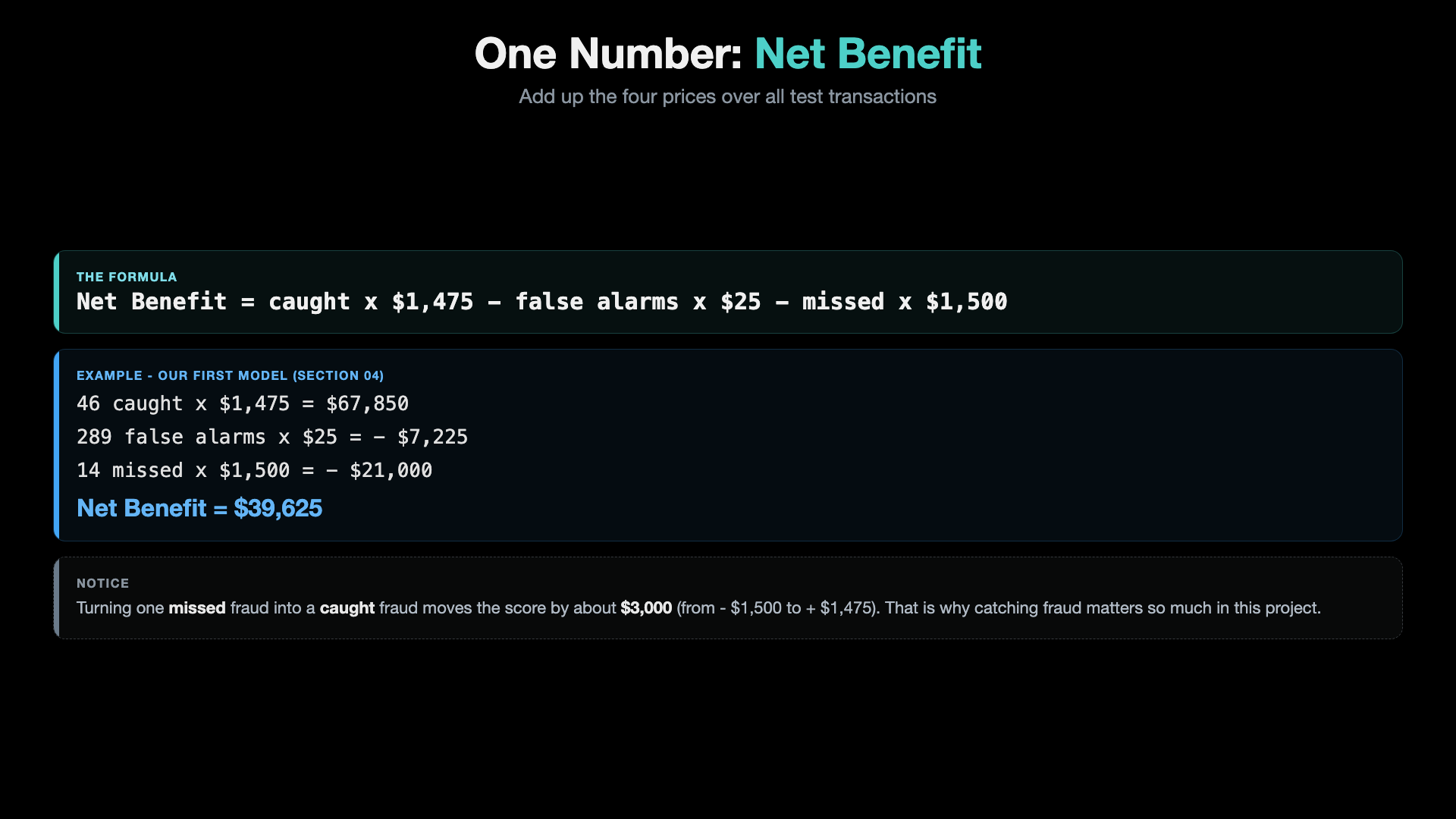
Net Benefit = caught x $1,475 - false alarms x $25 - missed x $1,500

First model (Section 04):  46 x $1,475 - 289 x $25 - 14 x $1,500 = $39,625
Notice: turning one missed fraud into a caught fraud moves the score by about $3,000 (from - $1,500 to + $1,475). That is why catching fraud matters so much in this project.
Step-04: The ML Workflow and How Our Project Follows It
Every machine learning project goes through the same basic steps. It is a loop, not a straight line: we come back to earlier steps whenever we learn something new.
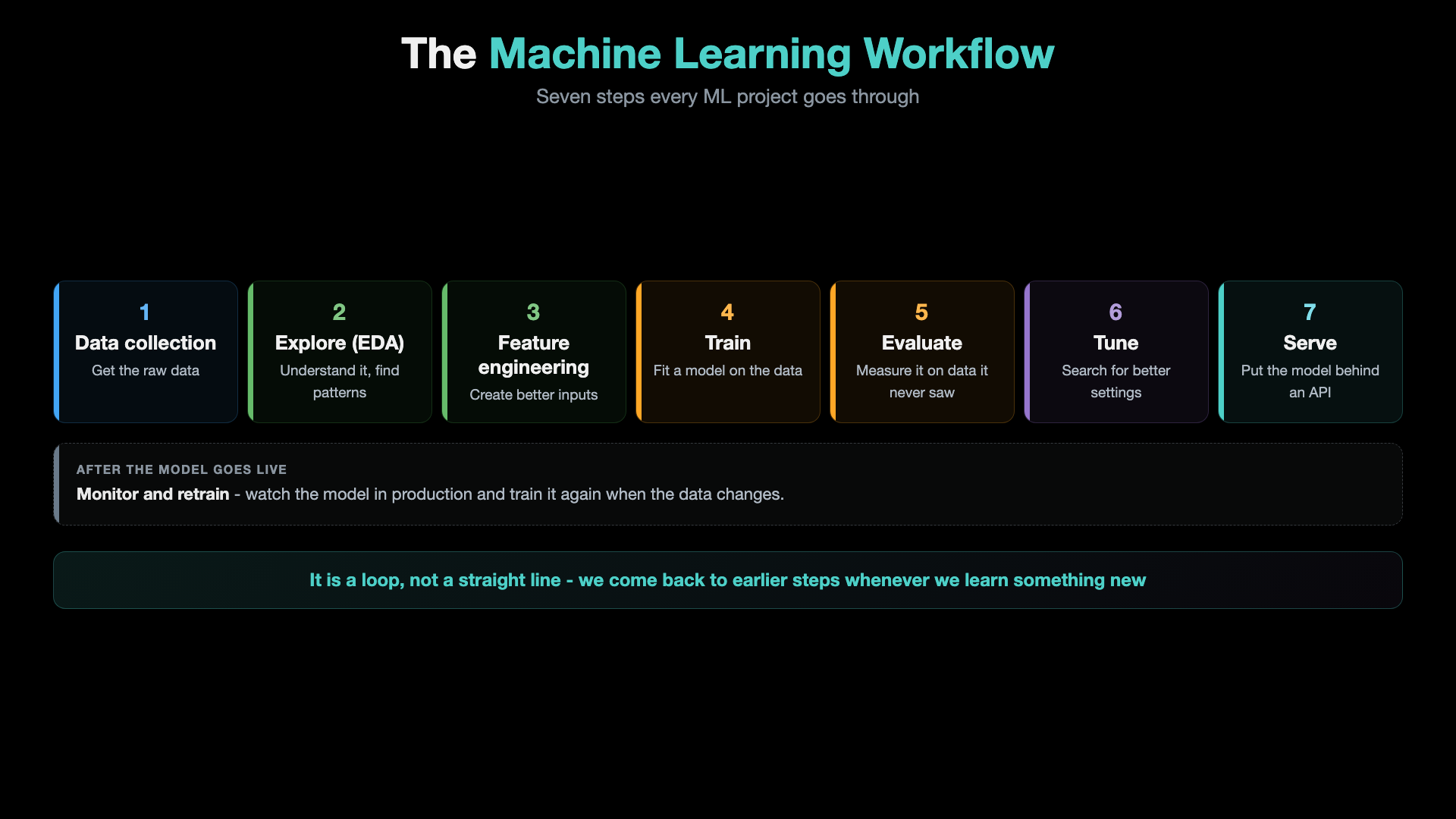
In our project, each step is a Python script, and each section builds one of them:
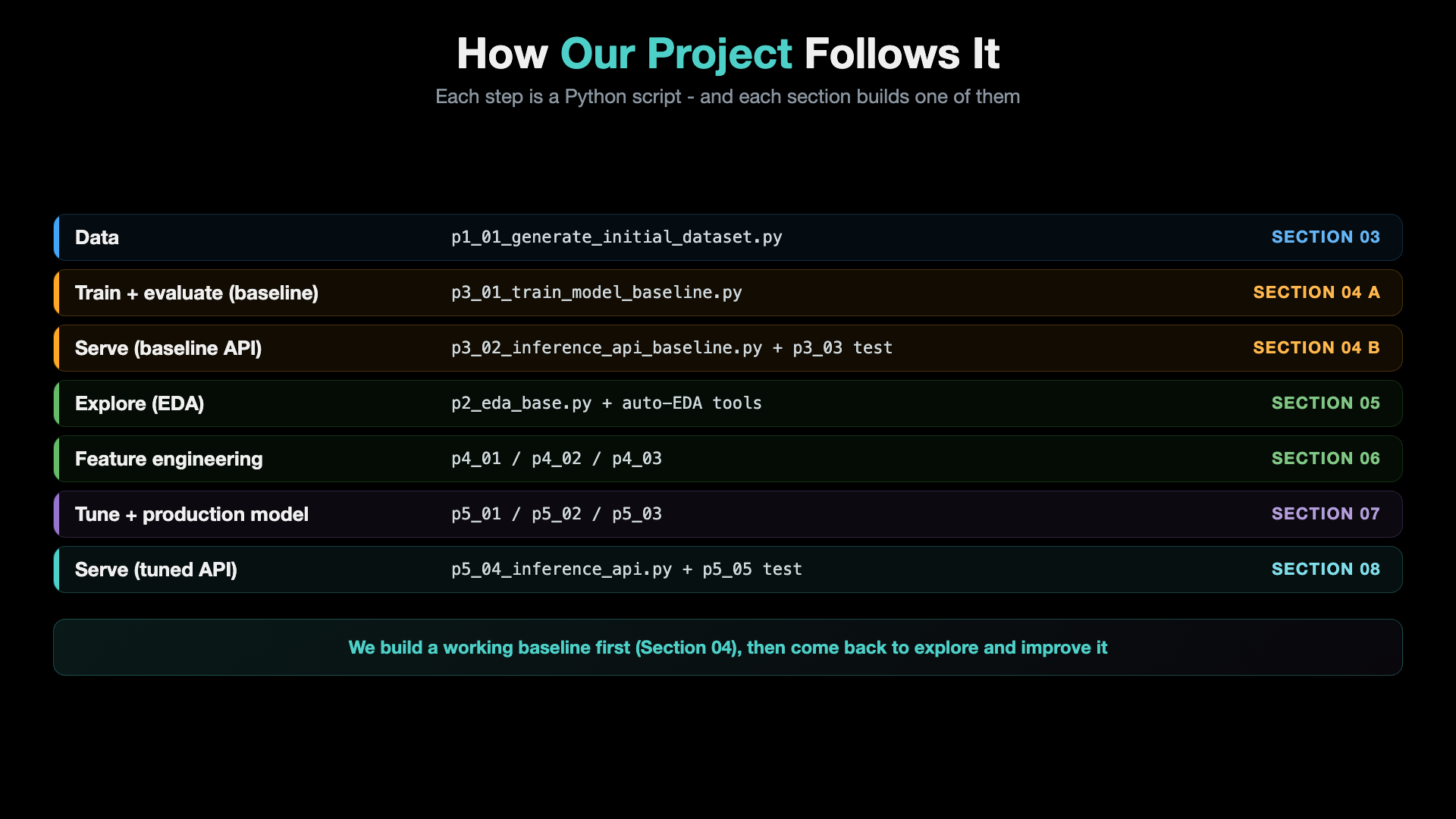
| Step | Script(s) | Section |
|---|---|---|
| Data | p1_01_generate_initial_dataset.py | 03 |
| Train + evaluate (baseline) | p3_01_train_model_baseline.py | 04 A |
| Serve (baseline API) | p3_02_inference_api_baseline.py + p3_03 test | 04 B |
| Explore (EDA) | p2_eda_base.py + auto-EDA tools | 05 |
| Feature engineering | p4_01 / p4_02 / p4_03 | 06 |
| Tune + production model | p5_01 / p5_02 / p5_03 | 07 |
| Serve (tuned API) | p5_04_inference_api.py + p5_05 test | 08 |
We build a working baseline first (Section 04), then come back to explore and improve it.
One idea runs through every section: train on one part of the data, test on a part the model has never seen.
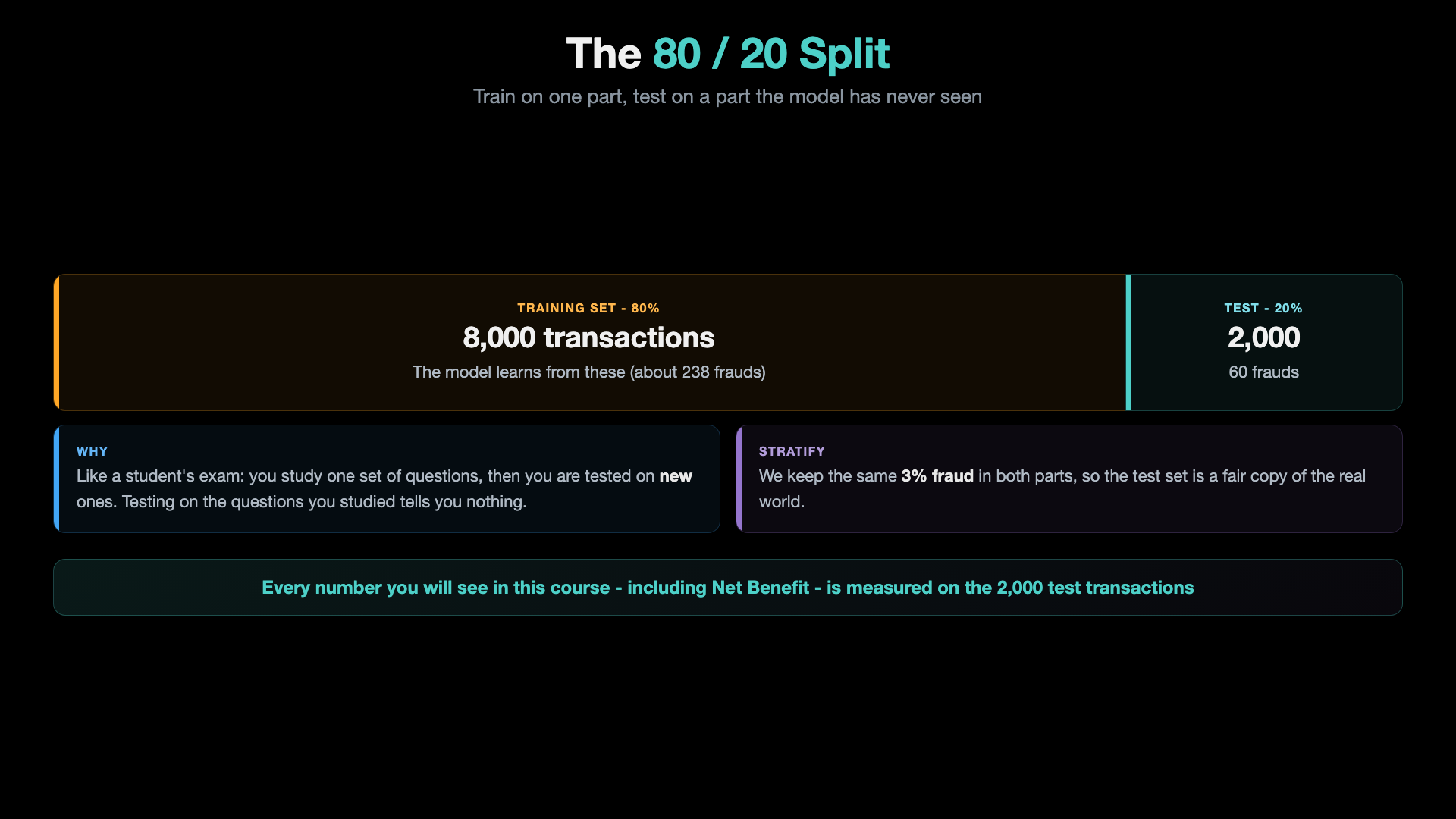
- Training set (80%): 8,000 transactions. The model learns from these.
- Test set (20%): 2,000 transactions, 60 of them fraud. Every number you will see in this course, including Net Benefit, is measured on these.
- Stratify: we keep the same 3% fraud in both parts, so the test set is a fair copy of the real world.
Next: 02 - Setup Python
Prefer to learn by watching?
The video course builds this whole project with you on screen, step by step.